Science Bulletins: Scientists Peer Inside "Superbug" Genome
For decades MRSA, or methicillin-resistant Staphylococcus aureus, has been afflicting hospital patients and prison inmates with life-threatening and ...
American Museum of Natural History
Science Bulletins: More Roads Encourage Wildlife Poaching
A sweeping satellite analysis by researchers at the Woods Hole Research Center shows that roads have expanded more than expected in central Africa's lush ...
American Museum of Natural History
Science Bulletins: New Evidence of Water on Asteroids
For the first time, researchers have detected water on an asteroid. Two research teams independently determined that the 24 Themis asteroid, which orbits ...
American Museum of Natural History
Science Bulletins: Human Stems Cell Breakthrough
A long-sought milestone has been reached in stem cell research: transforming adult cells directly into stem cells without having to use an embryo as a vehicle.
American Museum of Natural History
Science Bulletins: New Gene Implicated in Deafness
It is thought that mutations in several hundred genes can cause hereditary hearing loss. By generating random mutations in mice, a team of researchers led by ...
American Museum of Natural History
Science Bulletins: Hubble Tracks the Seasons of Pluto
NASA recently released images of Pluto taken by the Hubble Space Telescope in 2002 and 2003. When compared to images from 1994, the new images show ...
American Museum of Natural History
Science Bulletins: Blocking Malaria from the Blood
To fuel new malaria drugs, scientists are studying how malaria parasites gain access to red blood cells. Australian researchers recently discovered a surface ...
American Museum of Natural History
Science Bulletins: Making Faces for Survival
Ask any person, from any country‚ to make a fearful face and you'll get the same response-eyebrows raised, eyes wide open, flared nostrils. A disgusted face, on ...
American Museum of Natural History
Science Bulletins: The Roots of a Malaria Menace
Malaria kills more than a million people every year. Recently, an international team of biologists used genetic techniques to trace how the malaria parasite ...
American Museum of Natural History
Science Bulletins: Ancient Immunity May Have Upped HIV Risk
Retroviruses insert their genetic material into an organism's DNA to replicate. Over time, the viral DNA can inactivate and remain as a "fossil" relic the DNA ...
American Museum of Natural History
Science Bulletins: Planck and Herschel: The Sky at Two Scales
Planck and Herschel, a pair of satellites launched in 2009, are examining the sky in tandem to solve some of our biggest cosmological mysteries.
American Museum of Natural History
Science Bulletins: Full Gene Set Decoded for Three More People
In June 2000, scientists triumphantly announced they had deciphered the full human genome—the 3.2 billion units of DNA that make up the blueprint for human ...
American Museum of Natural History
Science Bulletins: Skull fills Gap in Fossil Record
Some periods of human prehistory lack a substantial fossil record in key geographic locations, making it difficult to confirm genetic evidence of modern human ...
American Museum of Natural History
Science Bulletins: Star Bolts from Crowded Nebula
No star-forming region in our local Universe is as vigorous as 30 Doradus, also called the Tarantula Nebula. Now astronomers have used NASA's Hubble Space ...
American Museum of Natural History
Science Bulletins: Ardi Unveiled
Fifteen years after the first fragments of a nearly complete skeleton of Ardipithecus ramidus were found in Ethiopia's fossil-rich Awash River Valley, ...
American Museum of Natural History
Science Bulletins: Curiosity Rover Heads for Mars
The biggest and most technically advanced rover to date is on its way to Mars. In the latest Astro Bulletin from the Museum's Science Bulletins program, follow ...
American Museum of Natural History
Science Bulletins: In Search of Wild Variety
To help build the catalog of life, biologists at AMNH search the globe for species that have never been scientifically described. Discover seven of these new ...
American Museum of Natural History
Science Bulletins: Signs of Speech Ability Seen in Neanderthals
Could Neanderthals speak? Researchers from the Max Planck Institute for Evolutionary Anthropology in Germany—the same team that sequenced large ...
American Museum of Natural History
Science Bulletins: Record- Breaking Fire Season
The southeastern United States is now in its worst drought in over a century. Lack of rain has exacerbated forest fires across the region. Parched bodies of water, ...
American Museum of Natural History
Science Bulletins: Genes and Geography—They Go Together
Scientists can now analyze a person's genes to pinpoint what country his or her ancestors hailed from. A team of U.S. researchers recently performed a massive ...
American Museum of Natural History
Science Bulletins: Skull X-Rays Reconstruct Extinct Carnivores’ Bite
Some carnivores eat only meat, while others are more omnivorous. To understand how and when these differences in carnivore feeding may have evolved, ...
American Museum of Natural History
Science Bulletins: Deep-Sea Cephalopods Hide Using Light
Many kinds of octopus, cuttlefish, and squid are masters of disguise. They conceal themselves using chromatophores—specialized skin cells that hold pigment ...
American Museum of Natural History
Science Bulletins: Genes in the Urban Environment
Much of who we are biologically is determined by an interplay between our genes and the environment we live in. To learn how the transition of human ...
American Museum of Natural History
Nature's Fury: The Risk Beneath Bangladesh
Follow geologists as they map a significant fault near the capital of Bangladesh and study how an earthquake on that fault could cause a river to shift ...
American Museum of Natural History
Science Bulletins: On Shaky Ground—Building a Safer Future in Haiti
In November 2010, ten months after a magnitude 7.0 earthquake flattened huge sections of Port-au-Prince, Haiti, a team of geologists commissioned by the ...
American Museum of Natural History
Science Bulletins: New Malaria Map
The international Malaria Atlas Project has created the most complete map of malaria risk in four decades. The team analyzed 4278 surveys of malaria infection ...
American Museum of Natural History
Science Bulletins: Swine Flu: Seeking Genetic Clues
Scientists are quickly sequencing the genes of the swine flu virus, officially called influenza A H1N1, from thousands of patients around the world.
American Museum of Natural History
Science Bulletins: Dung Beetles Help from the Ground Up
Dung beetles, also called scarab beetles, benefit humans and habitats worldwide as they process animal waste. In this video, learn how these insects help—and ...
American Museum of Natural History
Science Bulletins: "Hobbit" Study Takes a Step Forward
A recent study of the foot of the tiny extinct "hobbit" shows that this unusual hominid couldn't run easily. The work, which was led by AMNH research scientist ...
American Museum of Natural History
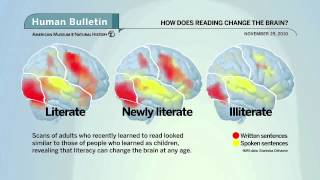
Science Bulletins: How Does Reading Change the Brain?
A recent study led by neuroscientists at France's National Institute of Health and Medical Research has found that learning to read—no matter at what ...
American Museum of Natural History
Science Bulletins: Neanderthal Genome Sheds Light on Humanity
Neanderthals were our closest relatives. These stocky, heavy-browed humans lived from about 200000 to 30000 years ago in Eurasia and the Middle East.
American Museum of Natural History
Science Bulletins: Baby Black Hole Lives Close By
Astronomers say a black hole recently formed in a nearby galaxy.
American Museum of Natural History
Science Bulletins: PETM - Unearthing Ancient Climate Change
Fifty-five million years ago, a sudden, enormous influx of carbon flooded the ocean and atmosphere for reasons that are still unclear to scientists. What is clear is ...
American Museum of Natural History
Science Bulletins: Cosmic Collisions Fuel Black Holes
Swift is a NASA satellite designed to spot gamma-ray bursts, the most powerful explosions in the Universe. They are named for the extremely energetic gamma ...
American Museum of Natural History
Major fire breaks out at natural history museum in Delhi | Manorama News
Major fire breaks out at natural history museum in Delhi | The official YouTube channel for Manorama News. Manorama News, Kerala's No. 1 news and ...
Manorama News
Science Bulletins: Brown Widow Spiders Invade Southern California
In the last decade, brown widow spiders have made a home for themselves in parts of Southern California, a region once dominated by the more venomous ...
American Museum of Natural History
Science Bulletins: The Risk Beneath Bangladesh
With a population exceeding 160 million in an area the size of Iowa, Bangladesh is Earth's most crowded nation. It also straddles several tectonic plate ...
American Museum of Natural History
Science Bulletins: Survivors of 1918 Flu Still Thwart Virus
The 1918 influenza pandemic was the deadliest ever recorded. At least 50 million people died before the strain mutated and vanished in 1919. Some of the ...
American Museum of Natural History
Science Bulletins: New Stem Cell Method Shows Promise
The University of Wisconsin-Madison researchers who turned ordinary skin cells into stem cells in 2007 have cleared a major safety concern of using those cells ...
American Museum of Natural History
Science Bulletins: Rare Disorder Sheds Light on Sociability
Ongoing studies of people with a rare congenital disorder called Williams Syndrome are revealing the genetic basis and brain activity behind their striking lack of ...
American Museum of Natural History
Science Bulletins: Tibetans Show Recent Evolution
To understand how the native people of the Tibetan plateau have adapted to their extreme low-oxygen environment, several research teams are comparing the ...
American Museum of Natural History
Science Bulletins: CT Scans Help Poached Rhinos
South Africa is home to more than 80 percent of Africa's remaining rhinoceroses, most of which live in national parks and reserves. But even in these protected ...
American Museum of Natural History