What did Neanderthals eat? | Natural History Museum
Natural History Museum scientists, working as part of the Gibraltar Caves Project, excavated and studied remains of shell fish and other marine animals such as ...
Natural History Museum
Science Bulletins: Reading the Rocks—The Search for Oil in ANWR
In 1980 an act of Congress set aside nearly 20 million acres of Alaska's North Slope tundra to create the Arctic National Wildlife Refuge (ANWR). Less than 100 ...
American Museum of Natural History
Science Bulletins: Evolution in Action—Isolation and Speciation in the Lower Congo Region
Central Africa's roiling, rapid Lower Congo River is home to an extraordinary assortment of fish—many truly bizarre. This new video by Science Bulletins, the ...
American Museum of Natural History
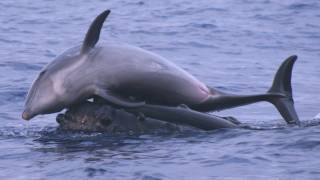
Science Bulletins: Whales Give Dolphins a Lift
Many species interact in the wild, most often as predator and prey. But recent encounters between humpback whales and bottlenose dolphins reveal a playful ...
American Museum of Natural History
Science Bulletins: Signs of Water Detected on Distant Worlds
Since the first extrasolar planet was discovered in 1995, astronomers have gathered and analyzed telescope data revealing over 1000 worlds orbiting other ...
American Museum of Natural History
Science Bulletins: Beyond Our Solar System—Searching for Extrasolar Planets
Astrophysicists are discovering new extrasolar planets—those outside our Solar System—almost daily. NASA's Spitzer Space Telescope (originally called SIRTF ...
American Museum of Natural History
Science Bulletins: Biodiversity Unveiled—New Animal Discoveries of 2013
From legless lizards to purring monkeys, scientists described thousands of unique animal species in 2013. Some species-rich regions like the Amazon basin ...
American Museum of Natural History
Science Bulletins: Another Star Found in Big Dipper
A long-hidden star in the Big Dipper's handle has come to light thanks to a precision imaging technique by members of Project 1640, a collaboration between ...
American Museum of Natural History
Science Bulletins: Cocaine's Tug-of-War in the Brain
Scientists from the Mount Sinai School of Medicine are probing neurons in the brain's reward center to learn why cocaine can be so addictive. A recent study ...
American Museum of Natural History
Science Bulletins: CT Scans Help Poached Rhinos
South Africa is home to more than 80 percent of Africa's remaining rhinoceroses, most of which live in national parks and reserves. But even in these protected ...
American Museum of Natural History
Science Bulletins: Curiosity Rover Heads for Mars
The biggest and most technically advanced rover to date is on its way to Mars. In the latest Astro Bulletin from the Museum's Science Bulletins program, follow ...
American Museum of Natural History
Science Bulletins: Autistic Brains Show Visual Dominance
After examining brain-mapping studies of hundreds of autistic people, scientists from the University of Montreal in Canada and Massachusetts General Hospital ...
American Museum of Natural History
Science Bulletins: Potato Biodiversity—Ensuring the Future
Farmers in the Andes use biodiversity as insurance. The potato, a plant native to the area that is now the world's fourth most important staple crop, is still locally ...
American Museum of Natural History
Science Bulletins: Melting Ice, Rising Seas
The rising temperatures of global climate change are melting the world's ice. Most notable are the shrinking ice sheets of Greenland and west Antarctica, which ...
American Museum of Natural History
Science Bulletins: Derecho
On July 4, 1999, a rare and terrifying storm swept through the Boundary Waters Canoe Area Wilderness in northern Minnesota. What began like a ...
American Museum of Natural History
Science Bulletins: Chernobyl's Birds Adapt to Radiation
The Chernobyl nuclear disaster had a high ecological cost, with local wildlife suffering from physical deformities and reduced populations. The site has since ...
American Museum of Natural History
Science Bulletins: Brain Evolution—The Sweet Smell of Success
A good sense of smell may have contributed to the development of certain kinds of social functions in Homo sapiens, according to a new study. Scientists used ...
American Museum of Natural History
Science Bulletins: Gravity—Making Waves
Gravity may seem elementary. But proving Einstein's theories about it is quite hard. To do so, scientists are struggling to capture gravity's most elusive hallmark: ...
American Museum of Natural History
Science Bulletins: Egg Patterns Identify Intruders
When cuckoos lay eggs in other birds' nests, they produce eggs similar in color and pattern to the hosts' own. With the help of a new computer program, ...
American Museum of Natural History
Science Bulletins: WISE Focus on Infinity
On September 30, 2010, a NASA space telescope called the Wide-field Infrared Survey Explorer, or WISE, completed its sweeping goal: to record observations ...
American Museum of Natural History
Science Bulletins: Deadly Larvae Lure Predators
Amphibians that try to feed on the larvae of the Epomis beetle will find that they've bitten off more than they can chew. Rather than avoiding its predators, the ...
American Museum of Natural History
Science Bulletins: Jupiter's Shrinking Storm
Jupiter is a planet of extremes—it's the biggest in our solar system, it spins the fastest, it hosts the most moons, and it has the most turbulent atmosphere. But one ...
American Museum of Natural History
Science Bulletins: Earth's Green Carbon Machine
The seasonal growth of plants—both on land and in the ocean—is one of the most striking patterns visible on Earth from space. This green "pulse" of life is ...
American Museum of Natural History
Science Bulletins: The Invasion: A Case Study on the Hudson River
Synopsis The zebra mussel, a notorious invasive species, has been silently infesting the rocky bottom of the Hudson River since it arrived there in 1991.
American Museum of Natural History
Science Bulletins: CLARITY Clears the Path to a See-Through Brain
A new approach to brain imaging called CLARITY could revolutionize how scientists study the brain. Researchers replaced a mouse brain's opaque fats with a ...
American Museum of Natural History
Science Bulletins: Brown Dwarfs—Tail End of the Stars
Journey to the heights of Mauna Kea in Hawaii where astronomers search for brown dwarfs, cosmic bodies that are not quite stars and not quite planets.
American Museum of Natural History
Science Bulletins: Congo River
New technologies are making it easier for scientists to map bodies of water such as the meandering lower Congo River in Africa. By programming computers to ...
American Museum of Natural History
Science Bulletins: Earliest Human Artifacts in Eastern Europe
Scientists have dated a set of unique artifacts found in Kostenki, Russia to 45000 years old—the earliest trace of modern humans in that region. They help clarify ...
American Museum of Natural History
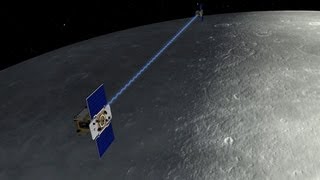
Science Bulletins: GRAIL Spacecraft Ready to Map the Moon
NASA's Gravity Recovery and Interior Laboratory (GRAIL) mission has put a pair of nearly identical spacecraft in orbit around the Moon. By using radio waves to ...
American Museum of Natural History
Science Bulletins: Hubble Space Telescope—25 Years and Counting
Few of NASA's telescopes have captured the public imagination like Hubble, with its spectacular views of distant galaxies, supernovas, and nebulas. The first ...
American Museum of Natural History
Science Bulletins: Sunken Remains Illuminate Native American Lineage
In an underwater cave in the Yucatán, divers discovered a near-complete human skeleton dating to the first wave of migration to North America. DNA evidence ...
American Museum of Natural History
Setting the stage for the blue whale skeleton move | Natural History Museum
Watch the scaffolding rising around our blue whale skeleton as the Museum gears up for a move of gigantic proportions. From the summer of 2017, the skeleton ...
Natural History Museum
Science Bulletins: Dung Beetles Mediate Methane
Agriculture produces enormous amounts of animal waste, which in turn emits great quantities of methane, a greenhouse gas that contributes to global warming.
American Museum of Natural History
Science Bulletins: The Cosmic Microwave Background—A New View from the South Pole
The icy South Pole desert is a harsh and desolate landscape in which few life-forms can flourish. But the extreme cold and isolation are perfect for astronomical ...
American Museum of Natural History
Science Bulletins: Roads Influence Animal Genes
Roads connect people, but they separate animals.
American Museum of Natural History
Mangroves: The Roots of the Sea (AMNH, Science Bulletins)
There aren't too many happy stories when it comes to restoring damaged ecosystems, but people in southern Thailand's Trang Province tell one of them, thanks ...
Mangrove Action Project
Science Bulletins: In Search of Wild Variety
To help build the catalog of life, biologists at AMNH search the globe for species that have never been scientifically described. Discover seven of these new ...
American Museum of Natural History
Science Bulletins: Continental Deformation: Creating the Basin and Range
American Museum of Natural History
Science Bulletins: Thinking in Symbols
Modern human culture underwent a "creative explosion" in Ice Age Europe 40000 to 10000 years ago. The evidence, which ranges from fantastic cave paintings ...
American Museum of Natural History
Science Bulletins: MESSENGER Mission to Mercury
The MESSENGER orbiter's January 2008 flyby of the planet Mercury was historic. The last time a spacecraft visited was 1975, and it only mapped half the planet.
American Museum of Natural History
Science Bulletins: Quakes from Space
In recent years, scientists have begun using satellite technology to study earthquakes from space. By monitoring the tiniest movements of the Earth's crust, they ...
American Museum of Natural History
Walking with Arachnids in the Natural History Museum's Spider Pavilion
Every spring the Natural History Museum of Los Angeles County opens up their pavilion, letting you walk through a spectacular environment of butterflies.
KCET